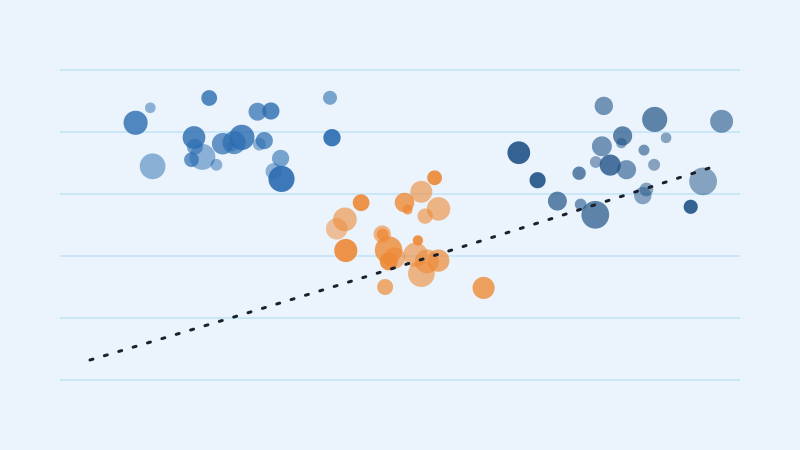
For decades, marketers and publishers have been obsessed with page views, average time on site, and – of course – the bounce rate. Sadly, these KPIs often leave stakeholders frustrated because they don’t necessarily reflect actual user engagement. In this post, I share a tag manager-based method to better measure whether users stay on the site long enough to read the contents of a page.
(more…)Blog
-

AI is intellectual fraud
From MeasureCamp Paris, June 14, 2025
So I walked into a packed room for my second session on AI. Apparently, “reason #3 will surprise you!” worked as a subtle clickbait hook on my session card. No pressure!
I did not build a slide deck for once so I‘m sharing a write-up of the session below.
(more…) -

Opt out of LinkedIn AI before November 3
Starting on November 3, 2025, LinkedIn will start to use some data from members to train content-generating AI models. That data can be from user profiles but also from posts and other user-generated, or user-provided content. Not that they haven’t used your data in the past, but better late than never, am I right?
At any rate, here is a super fast guide to opt out of LinkedIn AI.
(more…) -

Traffic consolidation with server-side tag management
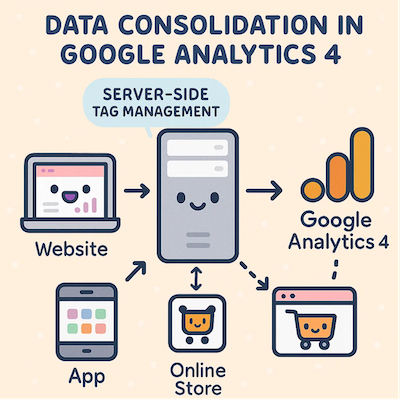
When you manage data for multiple websites and mobile applications, you will be tempted – with good reason – to consolidate the data into a single data source. Because we are now slimming down our data footprint, this post shows how to achieve data consolidation using server-side tag management. The post will be focusing for Google products, but rest assured this can be done with other vendors.
(more…) -
On expertise and client relationships
If you watched Better Call Saul, there is this episode where Kim Wexler, the attorney for large fictional bank Mesa Verde, fires them as a client after they repeatedly ignore her expert legal advice.
In the full episode, Saul Goodman was great at goading the client further towards ruin by playing on their emotions, while she remained the voice of reason, but that can be an excuse for another post.
My point is that if you’re going to hire outside expertise, it’s because you don’t have the skills or bandwidth to address a problem that your organization is facing. You’re hiring agency, competence, and experience.
You as a consultant come in and gather (then challenge & refine) requirements, come up with a plan based on your expert opinion and actual experience, then execute on the plan.
If your client ignores you or second-guesses your advice at every turn, you know it’s time for both parties to take a different path.

Image credit: SvetaZi/Getty Images This highly toxic behavior has a terrible effect on your self-confidence. If you were already suffering from impostor syndrome, this will only make things worse.
When you are part of a larger organization, there is a support structure to… support you with this type of situation. When you’re your own boss, however, you have to be able to manage that difficult client relationship.
You have to learn how to spot red flags and also back yourself up with facts and data. Depending on the level of corporate verbiage, here are a couple ways to provide reinforcement in communications:
- “I’ll make myself available for an in-depth review”: you’re offering time and energy to ensure your point is understood
- “How would you like me to measure whether I’ve implemented this correctly?” : let’s both agree beforehand on what success looks like
- “Help me understand where you’re coming from” : attempt to dispell misconceptions
- “Per my last email”: I’m referencing something important that was missed or ignored
- “This outcome was identified early on” : Corporate for “I told you so”

Set clear boundaries – Photo by Sylwia Bartyzel on Unsplash If you’re cynical, you will see the above as CYA. I for one see that as a way to establish clear work boundaries. Whenever possible, use active listening. This helps cement expectations and deliverables.
Unfortunately, despite your best efforts, there will come a time when that relationship with the client will become untenable because your advice is ignored or (worse) an adverse result can be misconstrued as failure on your part.
“It’s not me, it’s you”
This situation has happened to me a couple times as a freelance data consultant and, despite the fact that you are effectively ending a business relationship, you realize your energy and talent can be put to better use, without the toxicity and negativity you just experienced with that client.
Here are a couple ways to start broach the topic with your toxic client (apart from linking the video at the top of this post).
- “There appears to be a disconnect between the data-driven insights I’ve provided and the current strategic direction.”
- “The data strongly supports [your recommendation], and I’m concerned that deviating from this may lead to suboptimal results.”
- “My role is to provide data-backed recommendations. The current strategy seems to be operating outside of these insights.”
- “The evidence suggests a different course of action would be more beneficial. I want to ensure we are leveraging the data effectively to make informed decisions.”

It’s not me, it’s you — Photo by Kelly Sikkema on Unsplash “We’re done”
Once you’re at the point of no return, assuming you cannot objectively be at fault, you can use breakup phrasing such as:
- “Over the course of our engagement, it has become apparent that there is a fundamental difference in our approaches to [mention the area, e.g., data strategy, implementation]. As a result, I have decided to conclude our collaboration, effective [some date soon].”
- “While I appreciate the opportunity to have worked with [Client Company Name], it has become clear that our methodologies and priorities are not fully aligned. Therefore, I will be concluding our consulting engagement on [some date soon].”
What about you? Have you had to make tough decisions such as firing a client? Let me know in the comments.
-

Google Analytics 4 now offers benchmarking

Google Analytics 4 has introduced a benchmarking feature, enabling businesses to compare their performance against industry peers. While this functionality was previously available in the now defunct Universal Analytics, GA4 offers enhanced standardization through the use of reserved and recommended events, providing more accurate and reliable comparisons.
The process for enabling benchmarking in Google Analytics 4 is straightforward: just check the box labeled “Contribute to modeling” option in account settings to authorize Google to use your property’s data to feed the benchmarking model. In return, you gain a comprehensive overview of your position relative to competitors in terms of volume, conversions, and key behaviors.

It’s important to note that the quality of benchmarking results heavily depends on the participation of businesses & brands. The more data and the more consistent it is, the more meaningful the comparisons. Therefore, it’s crucial for businesses to accurately declare their industry, size, and correctly configure their conversion events.
The advantages of this new approach are manifold:
- Standardized measurements: Reserved and recommended events allow for comparison of similar metrics across different businesses, reducing bias caused by varying definitions.
- Focus on key events: By concentrating on industry-specific events (form submissions, purchases, bookings, games played, etc.), benchmarking provides more relevant insights for decision-makers.
- Competitive positioning: The ability to position oneself relative to the industry average allows for the identification of improvement opportunities and the setting of more ambitious goals.
However, certain limitations should be kept in mind:
- Dependence on declared data: The quality of results depends on the accuracy of information provided by businesses.
- Comparative nature: Benchmarking allows for performance comparisons but does not provide explanations for the reasons behind differences.
- Lack of in-depth competitive analysis: It’s not a tool for competitive intelligence but rather a means of obtaining a broader market overview.
In conclusion
GA4 benchmarking is a valuable tool for businesses seeking to assess their market position and identify areas for improvement. Nonetheless, it should be used judiciously and complemented by other analyses to make informed decisions.
-
New post on Medium on cookie death
I just published a new post on Medium in which I finally put the “death of the cookie” hoopla to rest.
Read the article : Cookies are delicious and I just can’t get enough
-

Google Analytics v4 is all grown up, and finally a freemium product
What if Google Analytics v4 (App+Web) was the best thing to happen to Google Analytics in the last 15 years? Will it finally give all the insights? Can I get free access to GA360? Will it cure cancer? Will it revive Steve Jobs?
All I know is that my data is going to be a lot tastier and scalable very soon – provided I add my credit card.
(more…) -

Apple ITP, Safari & analytics trackers – a flowchart
After all the hoopla around Safari v14 and unfounded rumors about Safari blocking Google Analytics, here is a handy flowchart to know where your digital marketing data collection stands:
-
Google Analytics eCommerce: upload product data with Google Sheets
In this post, I will show you how to streamline your eCommerce tracking implementation and upload product data to Google Analytics.
From a remote CSV file.
Over Google Sheets.
Automatically.Sounds good? Here we go!
(more…)