MeasureCamp Brussels 2026: where the data industry is heading
Also available inFrançais
UPDATE: Were you at my session at MeasureCamp Brussels? Visit my session card at https://mc.analytics-debugger.com/v/46558 You can get details, a link to the slides, rate my presentation, and leave a comment!
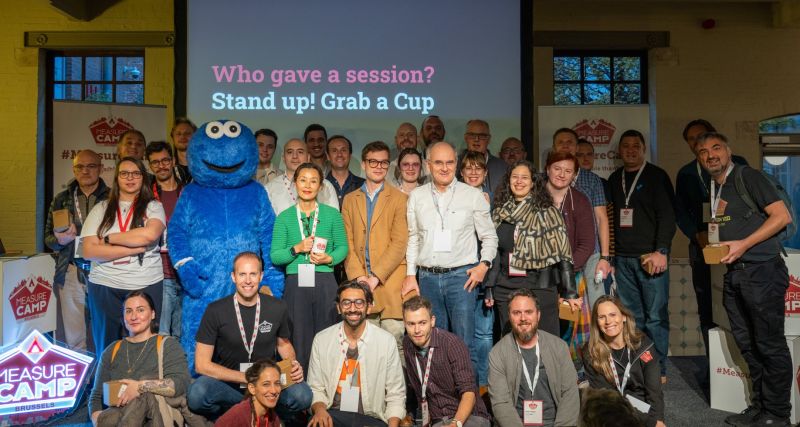
MeasureCamp Brussels held its seventh edition on 14 November 2026 at Les Ateliers des Tanneurs. Five rooms, eight time slots across the morning and afternoon, 39 sessions pitched on the day. Nobody curates a MeasureCamp programme, so what people choose to propose shows what the community worries about.
I obviously wasn’t able to attend all sessions. I compared notes with colleagues who are posting about the event, and I asked presenters questions during the coffee breaks.
The overall picture: the industry no longer asks whether to use AI. It asks what has to be true about the data for AI to be trusted, and most of the other themes are variations on that question.
AI is everywhere, and the analyst’s role is the open question
AI was the largest theme by far. Few sessions said “look what this tool does”. Most were about people and practice.
Krista Seiden (“Full Throttle Analytics”) described analytics moving from reporting what happened to exploring why and guiding what comes next. The analyst’s job shifts from building dashboards to interpreting behaviour and intent. Ivan Burban covered the organisational side: how an AI-agent workflow that works for one team becomes a company practice, with rollout phases, owners, shared context and guardrails.
Jim Kultgen opened with a live survey on how people really use AI in analytics, a useful check on the social-media picture of “5 Mac minis and a swarm of agents”. Marie Fenner (“Partnering With AI”) promised examples of insulting and insightful AI output, a reminder that quality control is now part of the job. Hussain Mehmood of Marketlytics asked “What Good Is A Human?”, and Johan Terpstra went further with “AI Identity Crisis” on society, economy and mental health. Yael Farkas looked at how AI will enhance human work through chatbots and personalisation, while Jean-Marc Courtiade showed a personal “digital clone” that automates repetitive tasks.
Aristide Riou gave the clearest builder example. Tired of the Google Analytics interface, he rebuilt one on top of BigQuery with an AI coding assistant.
Across these sessions AI is a colleague you manage and whose output you read critically, and nobody pitched it as a feature to switch on.
Documentation, semantic layers and agent-ready data
This was the sharpest technical consensus of the day: an AI agent is only as good as the context you give it.
Piotr Gruszecki (“Semantic Model For Conversational Analytics”) argued that semantic layers became essential because AI agents can’t work without them. He showed how to build one for Google Search Console, GA4 and ad platforms with Claude Code, Codex, Terraform, Schemachange and Snowflake. Tijs Van Autreve made the same point from the documentation side: AI analytics only works with the right documentation, and he wanted to compare what each team keeps in theirs.
In my own talk, “Analytics As Code” (Julien Coquet), I argued that a tracking plan belongs in Git, version controlled, reviewable and traceable, using a YAML-based governance approach. A machine-readable source of truth serves humans and agents equally.
Download my presentation Analytics as Code (PDF)
Lukas Cech tackled self-service analytics with “more questions than answers”. Maria Shcherbyna and Ivan Burban compared how agencies and in-house teams answer data questions today: dashboards, spreadsheets or AI chat.
Documentation, tracking plans and semantic models used to feel like overhead. On this board they are the interface between your data and your AI.
Tracking quality and server-side infrastructure
Underneath the AI talk sat an older worry: is the data even right?
Adrienne Vermorel (“Green Checks, Wrong Data”) covered four tracking traps and one real launch incident, plus what to check before declaring work done, including work done by AI agents. Mariusz Brucki pointed out that roughly 400 million people use ad blockers that can stop a consent management platform from loading, and showed which CMPs get blocked and how to fix it.
David Vallejo introduced TagRipper, an open-source tool for testing server-side setups. Niek Schlepers shared six months of request data on who crawls GTM infrastructure, including bugs found in his own bot detection. Robert Petković ran a live demo of the new Google tags in GTM in a multi-domain setup.
Server-side tagging is now common enough to need its own testing, security and monitoring practices.
Privacy and regulation, with a sense of humour
Compliance got two sessions built as a sequence, with a lot of audience participation. Nicolas Malo and Fabrizio Bianchi staged the “GDPR/AI Waffle Court”, putting two analytics stacks on trial with the audience as jury. Fabrizio Bianchi followed with “The Blue Slides”: the EU cookie rewrite, the AI Act deadline shuffle, the Data Privacy Framework and the fallout of political changes at the US FTC.
Fanny Marcoux offered a definition of ethical data built on six pillars, and Lucie Lafarge and Rebecca Tavel presented a reusable governance framework centred on risk.
The rules keep moving (cookies, AI Act, transfers), so teams want shared frameworks and rehearsed answers more than one-off audits.
Measurement: from clicks to margin, signed deals and incrementality
The measurement sessions shared a thread: stop feeding ad platforms the easy metric.
Olivier Guillaume of QUANTI proposed sending net margin instead of revenue to Google Ads and Meta, moving bidding from ROAS to POAS. Cost data comes from the ERP, margin is computed in the warehouse, and server-side tagging carries it back. Antoine Brion (LinkedIn) did the same for lead generation. CRM stages and signed-deal values go back as offline conversions through Enhanced Conversions for Leads and the Conversions API, so bidding targets deals and form fills stop being the goal. Antoine Tissier warned that A/B tests optimised only for checkout conversion let cancellations and returns eat the margin.
Francesco Schena hosted an MMM roundtable. Jonathan Thompson of Google showed how geo tests and marketing mix models complement each other with Google’s open-source Meridian. Ellie Hughes (LinkedIn) asked how much data a test needs to answer stakeholders with rigour, and Juliana Jackson shared what testing hundreds of assets for 75 large brands taught her about YouTube ads. Tim Ceuppens (“Value Creation vs Discounting”) looked at why discounts work and how they slowly damage a business.
Business outcomes (margin, signed deals, incrementality) are replacing platform proxies, and the plumbing for it is first-party, server-side and consent-aware.
Data teams, impact and organisational reality
A quieter group of sessions asked why good analysis still fails to change decisions.
Michel Bieze shared four lessons on getting from reporting to action so insights don’t end up in a drawer. Steen Rasmussen (“Decision Laundering”) drew on replies from 300 analysts to show how organisations use, and abuse, the data analysts give them. Yael Farkas, Juliana Jackson and Peter O’Neill hosted “No Stupid Questions” for juniors and seniors, and Peter O’Neill ran “Analytics Therapy” as a safe space for frustrations.
Alexandra Augusti and Fosca Fimiani discussed CDPs, from having none to going composable, and how to choose between building and buying. Sebastien Monnier and Morgan Bouvet showed how to expose data cheaply on GCP, from dashboards to custom videos. Maissa Larbi ran a debate on AI, analytics and data after a Microsoft outage.
As tooling automates, what sets analysts apart is influence, judgement and control of their own stack.
And a data rave
Francesco Schena turned Google Analytics data into techno in “The Data Rave”. Algorave, dance music made by live coding, is a pet topic of mine, so this one made me happy. If you’re curious, look into Strudel, a browser-based live-coding environment, and into artists such as DJ Dave and Switch Angel on YouTube and social media.
What the programme says about direction
- Context is the new bottleneck. Semantic layers, documentation and tracking plans as code were among the most concrete topics on the board.
- Checking matters more than automating. Green checks that lie, insulting AI output and decision laundering all point to the same skill.
- Platforms should get value, not volume. Margin and signed deals travel through server-side pipelines, with consent handled.
- Compliance keeps moving, and people tackle it with shared frameworks and humour.
- The analyst’s job is being redefined, from producing dashboards to interpreting, deciding and influencing.
The industry is trading dashboards for documented, governed, trustworthy data that machines can use, and it is still working out what that leaves for humans. The programme’s answer was judgement, communication and care.
The session cards (titles, speakers and abstracts) are still available on the MeasureCamp Brussels 2026 session board.
See you all next year! Check the MeasureCamp schedule for upcoming events. If the nearest city is too far from you, feel free to start your own!